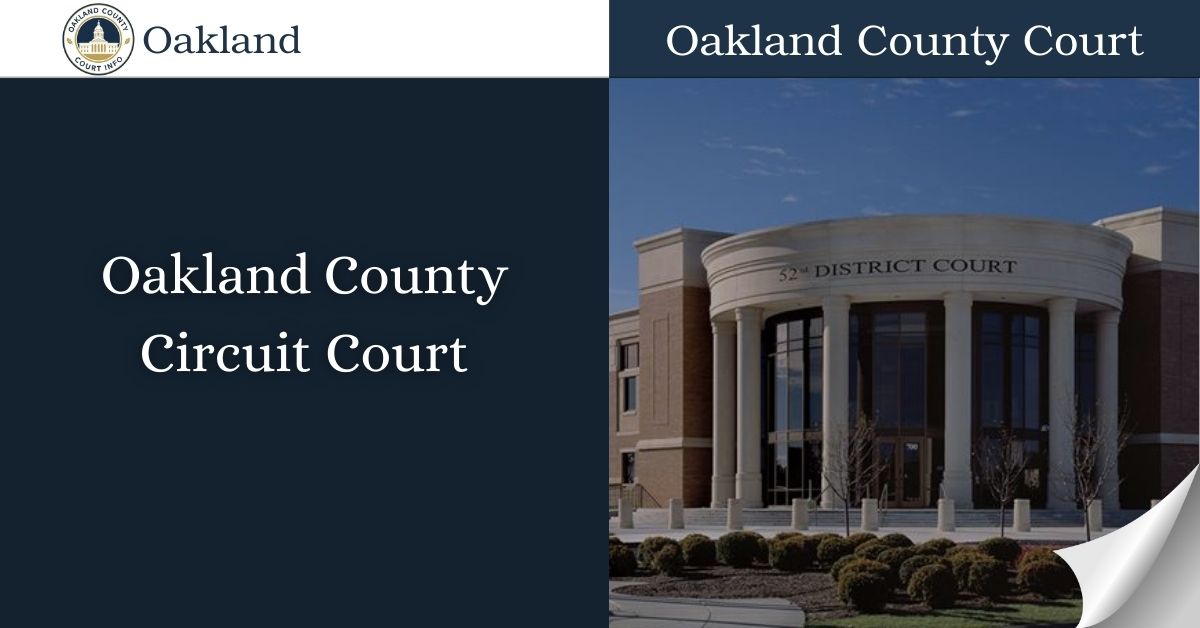
The Oakland County Circuit Court is the main trial court of general jurisdiction for all of Oakland County, Michigan. It handles major civil lawsuits, felony criminal cases, business disputes, and appeals from lower courts as part of the 6th Judicial Circuit. The court ensures fair and timely resolution of cases, providing a central legal authority for residents, businesses, and legal professionals throughout the county.
Located at 1200 North Telegraph Road in Pontiac, the Oakland County Court oversees divisions including civil, criminal, family, probate, and business courts, providing essential resources for filing cases, attending hearings, and accessing court records. As the primary judicial body for residents and businesses in Oakland County, the court manages all types of cases, from minor civil disputes to complex criminal matters, ensuring legal processes are conducted fairly and efficiently while maintaining public transparency. This page provides key information on the court’s services, contact details, and how each division functions to manage legal matters effectively and support accountability within the community.
What Is Oakland County Circuit Court?
The Oakland County Circuit Court is the primary trial court for Oakland County, Michigan, handling a wide range of cases, including civil, criminal, and appeals. It serves as a state-level court of general jurisdiction and is officially known as the 6th Judicial Circuit Court of Michigan.
6th Judicial Circuit: Scope and Structure
The 6th Judicial Circuit Court acts as a state trial court with authority to hear most cases arising in Oakland County. As a court of general jurisdiction, it handles civil disputes, criminal cases, family matters, and business-related cases, offering a centralized judicial system to resolve legal issues efficiently.
Key points about the 6th Judicial Circuit:
- Civil Cases: Disputes involving contracts, personal injury, property, and other non-criminal matters.
- Criminal Cases: Felonies and significant criminal matters, including preliminary hearings and trials.
- Appeals: Handles certain appeals from lower courts, ensuring proper legal review.
- Family and Business Cases: While family law primarily falls under the Family Division, certain complex cases may appear here. Business disputes are managed in specialized divisions (Business Court).
The court emphasizes fair and transparent proceedings, providing residents and businesses with a reliable venue for legal resolutions. It also maintains close coordination with the Oakland County Clerk’s Office and other judicial departments to support smooth case management.
Divisions of the Court
The Oakland County Circuit Court is organized into several divisions to handle different case types effectively. Each division is staffed by judges and specialized personnel to ensure cases are processed accurately and efficiently.
Civil / Criminal Division
The Civil and Criminal Division handles most standard cases:
- Civil Matters: Includes property disputes, personal injury, contract disagreements, and tort claims.
- Criminal Matters: Deals with felonies, arraignments, trials, and sentencing.
This division ensures that both civil and criminal matters receive dedicated attention while maintaining adherence to Michigan state law.
Business Division / Business Court
The Business Division (or Business Court) focuses on commercial and corporate disputes. Centralizing business litigation helps Oakland County:
- Streamline complex commercial cases
- Apply specialized business law expertise
- Reduce delays in corporate litigation
This division provides a structured approach to resolving disputes involving contracts, partnerships, corporate governance, and other business-related matters.
Family Division
While family cases are primarily managed by the separate Family Division, the Circuit Court occasionally interacts with family law matters, particularly when civil or criminal proceedings overlap. This includes:
- Domestic violence cases
- Child-related custody disputes tied to criminal matters
- Family-related appeals
Administration & Court-Wide Functions
The court’s administrative structure supports all divisions. Key functions include:
- Court Administrator’s Office: Oversees daily operations and policy implementation.
- Clerk’s Office: Manages filings, schedules hearings, and maintains public records.
- Support Services: Security, case management systems, and public resources ensure smooth operations.
LSI/NLP Keywords: Oakland County court divisions, business litigation, family law Michigan, civil court Oakland, court administration
Court Location & Contact Information
The Oakland County Circuit Court is located at:
1200 N. Telegraph Rd., Dept. 404, Pontiac, MI 48341-0404
Office Hours: 8:30 AM – 4:30 PM (Monday – Friday)
Visitor Rules: Weapons, cutting instruments, and other prohibited items are not allowed inside the courthouse.
Contact Information:
- Phone: (248) 858-1000
- Email: clerk@oakgov.com
- Online Resources: Forms, case searches, and fee information are available on the Oakland County Circuit Court website.
Search Court Records & Case Lookup
Searching for court records in Oakland County is simple when using the right methods. Users can access civil, criminal, and family cases efficiently online or in person, depending on the record type.
How to Search Court Records
The correct method for searching court records involves following these steps:
- Identify the type of case: Civil, criminal, or family.
- Gather identifiers: Case number, full party name, or attorney name. Using exact identifiers improves search accuracy.
- Select the search platform: Choose the official Court Explorer portal for most online searches.
- Filter by division or date: Narrow results using court division (civil, criminal, family) and filing date.
- Review results carefully: Check docket entries, hearing dates, and case status to confirm the correct record.
Using these steps ensures an efficient court search and accurate Oakland County case lookup.
Where to View Records and Costs
Users have multiple options to view and request Oakland County court records. Costs vary depending on whether the record is downloaded online, requested in person, or needs certification.
| Method | Access Type | Cost | Notes |
|---|---|---|---|
| Court Explorer (Online) | Recent civil, criminal, and domestic cases | Free to view online; $1–$5 per page to download or print | Most current cases available; older records may be limited |
| eFiling Portal | Filed case documents and motions | Fees per case or page, $1–$5 | Older cases (pre-1990s) are often only available in person |
| In-person at Courthouse | All case types, including historical records | $1–$5 per page; additional handling fees may apply | In-person at the Courthouse |
| Mail Requests | Copies of documents | $1–$5 per page + postage | For parties and attorneys, registration |
What Cases Does the Circuit Court Handle?
The Oakland County Circuit Court hears a wide range of legal cases, from serious civil disputes to major criminal offenses. It also reviews appeals from lower courts, ensuring that complex legal matters receive careful consideration.
Civil Cases & Civil Litigation
The civil court in Oakland County handles disputes between individuals, organizations, and businesses. This includes civil lawsuits, contract disagreements, property disputes, and claims for civil damages. Typically, cases involving amounts over $25,000 are heard in circuit court rather than in district courts, which handle smaller claims.
Civil litigation can take many forms. Contract disputes may arise from broken agreements, unpaid services, or purchase conflicts. Business litigation covers commercial disagreements between companies or corporate entities. Some of these matters are addressed specifically in the Business Court division, which focuses on complex commercial disputes.
Criminal Cases: Felony Court & General Criminal Jurisdiction
The circuit court handles serious criminal matters in Oakland County, including felony cases that involve significant penalties. Felony offenses include violent crimes, large-scale theft, fraud, and other major offenses that exceed the jurisdiction of district courts.
Unlike district courts, which manage misdemeanors and lesser offenses, felony cases are often bound over from lower courts to the circuit court for trial. The court also hears appeals from district courts and probate courts, ensuring consistency and oversight in criminal justice.
Criminal jurisdiction highlights:
- Felony trials: Homicide, assault, robbery, and large-scale theft.
- Criminal appeals: Cases where defendants appeal decisions from lower courts.
- Pretrial and post-trial motions: Circuit court handles bail hearings, sentencing, and post-conviction relief.
This structure allows Oakland County to manage complex criminal matters efficiently while maintaining procedural fairness.
Other Types of Cases & Matters
In addition to civil and criminal cases, the circuit court addresses several specialized matters:
- Business/Commercial Disputes (Business Court): Complex disputes between companies or commercial entities may be handled in the Business Court division of the circuit court.
- Family and Domestic Matters: While family law primarily falls under separate courts, some domestic or juvenile cases may reach the circuit court, especially on appeal or in conjunction with other matters.
- Probate and Juvenile Appeals: Circuit court reviews decisions from probate courts, including estate disputes, guardianships, and juvenile cases.
This broad jurisdiction ensures that Oakland County Circuit Court functions as a central legal forum for high-stakes civil, criminal, and specialized cases, providing consistent oversight across multiple areas of law.
How to Access the Court: Services & Public Access
Oakland County Circuit Court provides multiple ways for residents to access court records, view hearings, and use other public services. Visitors can use online tools or visit the courthouse in person, depending on the case type and the information they need.
Court Explorer & Case Search / Records Search
Court Explorer is Oakland County’s official portal for searching publicly available court records. It allows users to search by case number or party name across civil, criminal, domestic, and other case types.
Through Court Explorer, residents can access records for civil lawsuits, criminal cases, domestic relations, and probate matters. Most records from the early 1990s onward are available online, while older records may require a written request or an in-person visit. This tool ensures transparency and allows users to stay informed about court activity efficiently.
e‑Filing / Electronic Filings
Electronic filing, or eFiling, is available for most civil, domestic, and many criminal cases through MiFILE. This system enables the public to submit filings without visiting the courthouse.
Residents can create an account on the eFiling portal to submit new cases, upload documents, and track filing status. The portal provides instructions and forms needed for each type of case. For assistance, the clerk’s office can be contacted via email or phone. Some case types are not eligible for eFiling. Users should confirm eligibility on the court’s website or by contacting the clerk before attempting to submit documents electronically.
Court Docket & Hearing Schedule Access
The public can view upcoming hearings and docket entries through Court Explorer or the docket portal. The docket provides essential details, including hearing dates, times, locations, case numbers, parties involved, and the status of the case. This information allows parties, attorneys, and other interested individuals to track court activity and prepare accordingly. Accessing the docket online reduces the need for phone calls or in-person inquiries.
Ordering Court Documents & Public Records / Certified Copies
Court documents can be ordered online or in person, with certified copies available for an additional fee. Residents can search for cases in Court Explorer, select the documents they need, and request either regular or certified copies. Fees are typically $0.50 per page for standard copies and $3–$5 for certified copies. Older cases may require a written request or a personal visit to the clerk’s office. This process ensures that both historical and recent records remain accessible to the public.
Additional Services — Indigent Defense, Public Access, ADA, etc.
Oakland County Circuit Court provides services including ADA accommodations, indigent defense support, and assistance for public access. The courthouse strictly prohibits weapons and cutting instruments for safety. ADA accommodations include accessible entrances, assistive devices, and language support for visitors with disabilities. Indigent defense services are available for qualifying defendants, ensuring legal support is accessible to those in need.
Why is Circuit Court Used Instead of District Court?
The Oakland County Circuit Court handles serious criminal cases, high-value civil disputes, and appeals from lower courts, providing a forum for matters that exceed the authority of district courts. Court Dockets play a crucial role in this process, as they organize and schedule all cases, ensuring that each matter is addressed efficiently and in proper order. The circuit court ensures that complex legal issues are thoroughly reviewed and fairly resolved. Circuit courts handle more serious legal matters and larger disputes that district courts cannot. They are the main venue for felonies, major civil cases, and appeals from lower courts.
In Michigan, the court system separates cases based on type, seriousness, and the amount involved. District courts manage misdemeanors, traffic violations, small civil claims, and preliminary hearings for felonies. By contrast, circuit courts have general jurisdiction, allowing them to hear nearly all other cases, including those too complex or significant for lower courts.
Criminal Cases: Felonies vs Misdemeanors
Criminal cases are divided between lower and higher courts based on severity. Minor offenses and misdemeanors are handled in district courts, while serious crimes fall under circuit court jurisdiction. A key difference between circuit and district courts lies in criminal case handling. District courts deal with misdemeanors and minor offenses, while circuit courts handle felonies and serious crimes. Many felony cases start with a district court preliminary hearing but are bound over to circuit court for trial.
For example, cases such as armed robbery, first-degree assault, or large-scale fraud initially appear in a district court but move to the circuit court for full proceedings. Complex drug trafficking cases or homicide charges bypass district courts entirely and go straight to circuit court. Circuit courts also provide a venue for appeals from district court decisions. If a defendant or plaintiff believes the lower court made a legal error, the circuit court can review and decide whether to uphold, reverse, or modify the previous judgment.
Civil Cases: High-Value and Complex Disputes
Civil cases are assigned based on the monetary value and complexity of the dispute. Circuit courts handle larger or more intricate civil matters that district courts cannot accommodate. In civil matters, the amount at stake often determines the court. District courts generally hear cases with claims of $25,000 or less, while circuit courts handle claims exceeding $25,000, as well as complex business disputes, probate matters, and other sophisticated civil litigation.
Examples of cases heard in circuit court include large personal injury claims, commercial contract disputes, and property litigation involving significant assets. Handling these cases in circuit court ensures that the proceedings receive appropriate attention, resources, and procedural depth. Some civil disputes may begin in a lower court but are transferred to circuit court when the claim surpasses the monetary threshold or involves more complex legal issues. This transfer ensures fairness and the proper application of Michigan law.
Appeals from Lower Courts
Circuit courts review decisions from district courts to ensure proper legal procedures were followed. They act as both trial and appellate courts for certain cases.
Beyond original trials, circuit courts also act as appellate courts for district court cases. They review decisions in criminal and civil matters, ensuring that legal procedures are correctly followed. This role reinforces the circuit court’s position as both a trial and appellate authority in Michigan’s judicial system.
Table Example for Quick Reference:
| Case Type | District Court | Circuit Court | Examples |
|---|---|---|---|
| Criminal | Misdemeanors, minor offenses | Felonies, serious crimes | Armed robbery, first-degree assault |
| Civil | Claims ≤ $25,000 | Claims > $25,000, business disputes | Large personal injury, commercial contracts |
| Appeals | None | Appeals from district court | Review of lower court decisions |
Court Administration: Judges, Caseload, Workload, and Resources
The Oakland County Circuit Court operates with around 20 elected judges supported by a Court Administrator’s Office and several divisions. Because it handles a wide variety of civil, criminal, family, and business matters for a large population, it relies on substantial administrative resources to manage scheduling, filings, and court operations.
Judicial Structure and Number of Judges
- The court is formally the 6th Judicial Circuit Court, covering all of Oakland County.
- It employs roughly 20 elected judges, along with a Court Administrator’s Office and three main divisions: Civil/Criminal, Family, and Business.
- The Civil/Criminal Division alone includes about 13–14 judges handling civil and felony criminal cases.
- The Family Division handles divorce, child custody, juvenile, and other family‑law matters.
- The Business Division supports complex commercial litigation and administrative services for the court system.
Because data sometimes vary, “around 20 judges” is a reasonable approximation of current staffing.
Caseload Diversity and Workload Demand
As a general‑jurisdiction court, the Oakland County Circuit Court deals with a wide range of cases, including:
- Civil lawsuits (especially when claims exceed $25,000)
- Serious criminal cases (felonies) and appeals from lower courts
- Family‑law matters: divorce, child custody, adoptions, juvenile delinquency, guardianships, and more
- Business and commercial disputes are resolved in specialized business‑court settings
Because of this volume and variety, the court supports: a Case Management Office (to schedule and track cases), a Jury Office (to manage jury selection and operations), and administrative staff (clerks, support personnel).
Resource Allocation and Funding — Operational Reality
Running a court of this size and complexity requires steady funding and resources. The court obtains revenue through:
- Filing fees and statutory court costs
- Service fees for various filings and processes
- Grants or funds for specialized programs, such as treatment courts and alternative‑dispute initiatives
On the administrative side, the Business Division — which handles financial and resource management — covers budgeting, data‑technology support, and resources for treatment programs and care of court wards.
Why Strong Administration Matters
- With many different kinds of cases under its purview — civil, criminal, business, family — the court must coordinate schedules, track filings, assign judges, manage juries, and support court staff. A well‑structured administrative framework makes that possible.
- The presence of separate divisions (Civil/Criminal, Family, Business) helps allocate cases to judges with relevant expertise.
- Administrative staff and resources help ensure cases move efficiently, preventing delays that often occur when courts are overloaded.
- Funding via fees and statutory costs helps sustain the court’s staff, technology, record‑keeping, and programs that support fair process.
Location of Oakland County Circuit Court
The Oakland County Circuit Court is located in Pontiac, Michigan, at a central and accessible address for residents and visitors. Anyone needing to attend court proceedings can find the courthouse at 1200 N. Telegraph Rd., Dept. 404, Pontiac, MI 48341-0404.
Courthouse Address & Directions
The courthouse is situated in the heart of Pontiac, with easy access from major roads, including Telegraph Road and Woodward Avenue. Nearby landmarks include the Pontiac Transportation Center and the Oakland County Administration Building, making it straightforward to locate.
Public Transportation:
- SMART Bus Routes: Several bus lines stop near the courthouse along Telegraph Road.
- Train: The Amtrak station is approximately 2 miles from the courthouse.
Parking Options:
- On-site parking: Limited visitor parking is available near the courthouse entrance.
- Public parking lots: Nearby lots provide additional spaces for visitors.
- Accessibility: Designated handicapped parking spots are available close to the main entrance.
Clear signage and well-maintained sidewalks make it easy for visitors to move from parking areas to the courthouse.
Contact Information
For inquiries, residents can contact the court via phone, email, or in person.
Phone Numbers:
- Main Clerk’s Office: (248) 858-0800
- Civil Division: (248) 858-0801
- Criminal Division: (248) 858-0802
Email:
- General Inquiries: clerk@oakgov.com
Hours of Operation:
- Monday–Friday: 8:30 AM – 4:30 PM
- Closed on weekends and public holidays
Having these contacts readily available helps residents quickly resolve questions about court filings, case status, or procedural requirements.
(FAQ)
Oakland County Circuit Court handles a wide range of legal matters, including civil, criminal, and family cases. Residents often have questions about court procedures, records, and services, and this FAQ addresses the most common inquiries.
What is the difference between circuit court and district court in Oakland County?
Many residents are unsure which court will handle their case. Understanding the distinction helps avoid filing errors and ensures the correct court procedures are followed. Circuit Court handles more serious legal matters, such as felony criminal cases, civil cases over $25,000, and family law disputes. District Court deals with misdemeanors, traffic violations, small claims, and preliminary hearings for felonies. Circuit Court judges oversee jury trials, complex civil cases, and appeals from the District Court. District Court provides faster resolutions for minor offenses and preliminary legal procedures.
What types of civil cases go to Oakland County Circuit Court?
Civil cases in Circuit Court typically involve higher stakes or complex legal issues. Knowing which matters are heard here helps parties prepare for proper procedures. Circuit Court hears civil cases where the amount in controversy exceeds $25,000 and complex matters like contract disputes, personal injury claims, and property disputes. Civil cases include business litigation, landlord-tenant disputes beyond small claims limits, probate matters, and estate disputes. This court ensures structured procedures, including discovery, motions, and trials.
Can I access public court records online? How?
Many people want to review case information without visiting the courthouse. Online access can save time and simplify research. Certain court records are available online through the Oakland County Clerk’s eServices. The portal provides access to case dockets, court calendars, and some filings. Users can search by case number, party name, or attorney. Sensitive or sealed records require special permission or an in-person request to protect privacy.
How do I request certified copies of court documents?
Certified copies are official records often needed for legal or financial purposes. Knowing how to request them ensures you receive valid documentation. Requests can be made through the Oakland County Clerk’s Office in person or by mail. Required information includes case number or party name, a completed request form, and payment of fees. Certified copies serve as official proof recognized by courts and government agencies.
Is eFiling available for my case?
E-filing allows parties to submit court documents electronically. This modern system is widely used for civil and family law cases. The eFiling Michigan system lets attorneys and self-represented litigants file documents online. Benefits include instant confirmation, document tracking, and reduced in-person visits. In some cases, such as criminal felony filings, they still require traditional submission.